
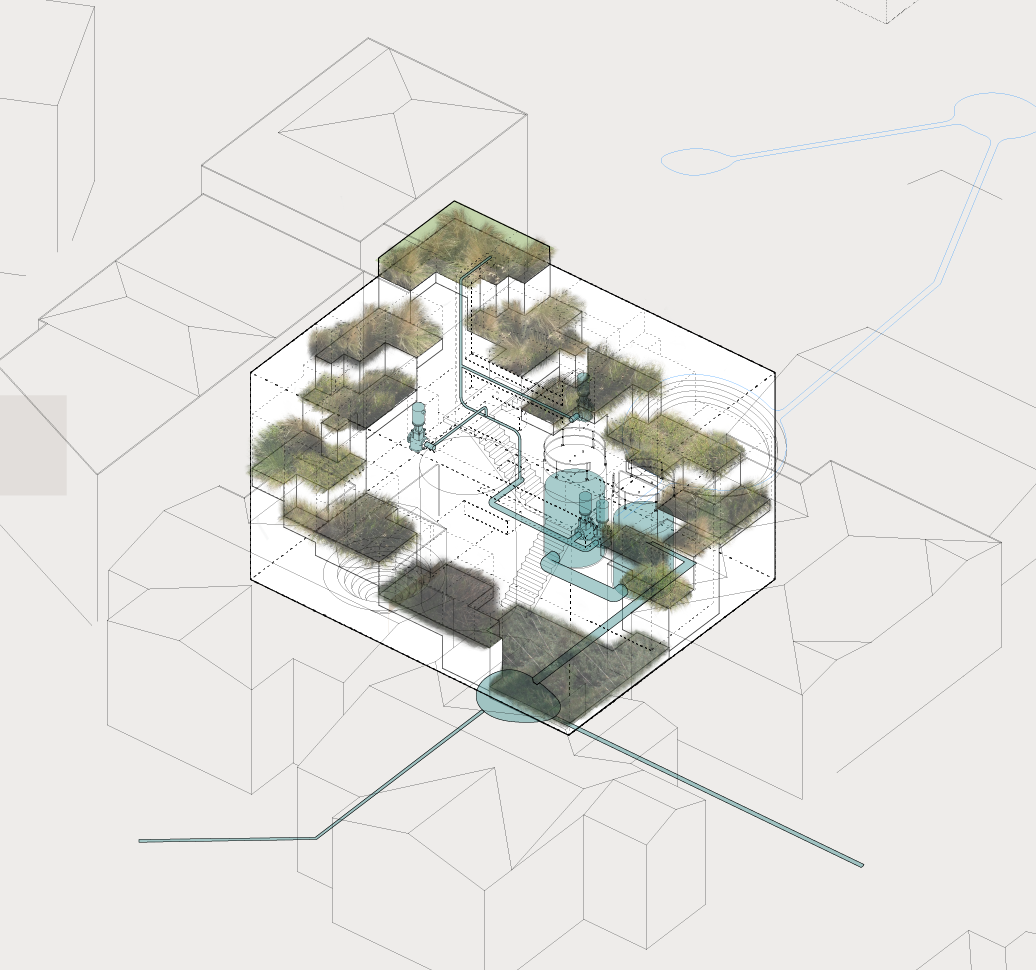
The Pores and Pipes project addresses the critical hydrological challenges facing Elwood, a suburb built on former low-lying wetlands now susceptible to increased flood risk and rising sea levels. This innovative urban design strategy proposes a decentralized water management system to mitigate flooding and enhance ecological resilience.
The scheme introduces a cellular urban fabric, where residential blocks are reimagined as hydrological units. These "cells" incorporate a network of water retention ponds that channel stormwater runoff towards centralized "filtration buildings". These hybrid structures synthesize residential and ecological functions, integrating apartment living with constructed wetlands to create a new architectural typology that blurs the boundaries between interior and exterior environments.
Section of filtration building connecting to drainage ponds
A distributed system of drains, strategically positioned throughout public and private domains, forms the capillary network of this water-centric urban landscape. This infrastructure not only serves a practical purpose but also becomes an integral part of Elwood's evolving identity, transforming the suburb's relationship with water from adversarial to symbiotic.
By intercepting and treating stormwater locally, the project aims to reduce the burden on the Elwood Canal and minimize the energy-intensive process of sewage treatment for potable water redistribution. This approach not only mitigates flood risk but also creates a more sustainable and resilient urban ecosystem, adaptable to the challenges posed by climate change and sea level rise.